Susie Joyce
Susie Joyce is a sculptor, printmaker, collage artist and painter who lives and works at Stradbroke in Suffolk. Born in Oxford in 1943, she studied textile design and printmaking at Ealing School of Art then studied sculpture part time at Hammersmith School of Art ceramics at West London University She studied painting at the New Richmond School of Art with David Wiseman, with whom she went on to paint in acrylic, and life drawing with Jeremy Gale in the approach of Cecil Collins. She joined West London Artists as a painte.
Alongside her own work she has been a textile designer, has taught textile design at The American College in Richmond and at Hounslow Borough College, now West Thames College, has taught private art classes, and has worked as an interior designer and project manager.
She moved to central London, first to Hampstead and then Clerkenwell. She studied etching and life drawing at the Prince's Drawing School in Shoreditch; and she held a studio at Space Studios, The Triangle, London Fields, Hackney; Susie gained two diplomas in sculpture at Kensington and Chelsea College; and at the same time took bronze casting courses at Meltdowns in Ramsgate, Kent, where she made five pieces in bronze. Between 2010 and 2012 she and her husband bought a barn in Suffolk, where she designed and project managed the conversion of a 500-year-old barn into her home, and creating the building beside it into a large studio. In 2015 she was elected to the National Acrylic Painters' Association (NAPA). She is a member of Suffolk Open Studios and of the Aldeburgh Artists Collective.
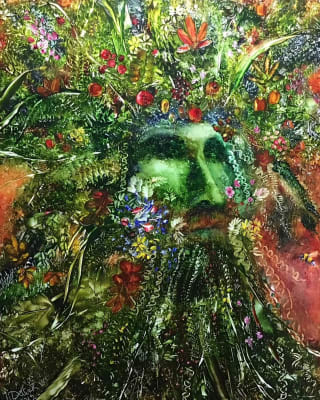
As a painter she works in acrylic on canvas, building up washes and overlaid layers and applying the paint thinly in some places and heavily in others, so that the texture forms the image and a mix of translucent and dense passages gives depth and richness of colour. She also uses watercolour, gouache, oil and soft pastel, on their own or together. Her subjects are often things that have been thrown away and regarded as rubbish, painted from her own photographs so that their patterns, shapes, colours and abstract qualities can be seen anew; others come from the sketches she makes wherever she travels, which serve as a pictorial diary. One series of acrylic paintings is drawn from photographs of a large scrapyard in Suffolk, which she crops into smaller and smaller details in order to abstract and manipulate the image and bring out shape and texture, colour and tone, showing that there is beauty in what has been abandoned and asking the viewer to look at things differently.
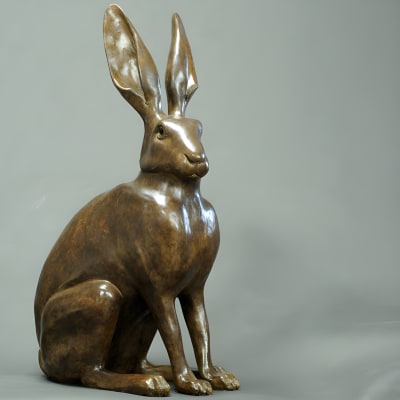
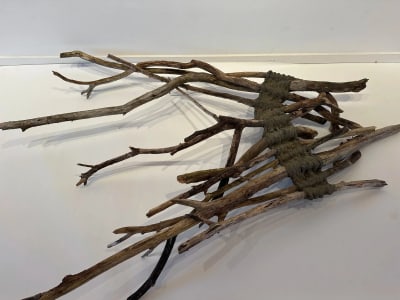
Her sculpture grows from a sense of movement and feeling that she finds intuitively through playful abstraction, and she has a fondness for visual jokes. She experiments with new materials such as rusty iron, and works with clay, breeze blocks, plaster, wood, plastics, board and building materials. She has also cast her ceramic work in bronze, a labour-intensive process that she found most creative at the wax stage. Her assemblages, collages, constructions and framed three-dimensional pieces are made from found objects, many of them rusty, which she finds beautiful and charming for their often random shapes and rich colour; an object may be chosen for its colour or shape, for a sentimental tie to a time, place or person, or simply because its form works with others. The shelf assemblages are built around themes or restricted palettes, and every shelf has to work with the rest, so a piece is often partly dismantled and rethought when only a small part of it succeeds. Her materials include rusty tools from the land where she lives, gifts from builder and gardener friends, finds from her travels, and pieces retrieved from heaps of crushed brick hardcore: shattered cast-iron cisterns, shards of bathroom tile, wire twisted into curious shapes and set in lumps of concrete, oak offcuts, Suffolk pavement tiles, wood and metal burnt on builders' bonfires, beads and plastic flowers, bottles, car parts and farm ironwork. Visitors to her exhibitions sometimes identify objects she cannot, such as a drill part from a plough or an equestrian curry comb, and these become stories attached to each piece. Vases of flowers, a subject she loves, recur in her three-dimensional collages and in her sculpture.
In printmaking she has worked mostly in etching, aquatint, sugar lift and chine collé, and she also makes lino prints, using two or three plates for colour, with subjects drawn largely from her sketchbooks. Across every medium, her work is about her passion for colour: how colours relate to one another, and how they help to create form and space.
Artist Statement
My practice is about space, form, and colour. I have a large collection of discarded items in my studio which I then transform into sculptures, collage and assemblages. Some works are more like collages which I then have framed.
I feel that I am transforming discarded objects, and I create something that is renewing, transforming, intriguing, thought provoking and sometimes, though not necessarily, beautiful, sculptures and assemblages. I make collages of paper, old prints, and found objects, I like hands on approach and I love printmaking because of this. Colour is very important in all my work.