Abbie Schug
Schug is a graduate of the University of Northampton with BA (Hons) Fine Art: Painting and Drawing (2015 - 2018) and MA Fine Art (2018 - 2019). Shortlisted for CVAN Platform Graduate Award (nominated by MK Gallery. 2019)
Her work was selected for the Trinity Buoy Wharf Drawing Prize, London (2024). With other group exhibitions including - Unconsumed II, The Shoe Factory, Norwich (2024), Summer Contemporary, Britten Pears / Snape Maltings (2024); Interface, Asylum Studios (2023); Emergence, Rise Art London (2020); MK Calling 2020, MK Gallery, Milton Keynes (2020); Quickly Moving, NN Contemporary (2019).
Schug’s research project “Simulated - Quasi-Human Artefacts of Post-Digital Data Generation” was first presented at DigitalPaintingPhotography International Symposium (2021), and later published in “Painting, Photography and the Digital: Crossing the Borders of the Mediums” (Robinson, C. 2022. Cambridge Scholars Publishing.).
Artist Statement
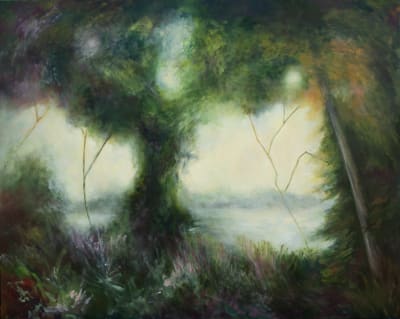
I am fascinated by the transfer, mediation and translation of data between digital and painterly interfaces - particularly data that visually refers to, or originates from, the human form.
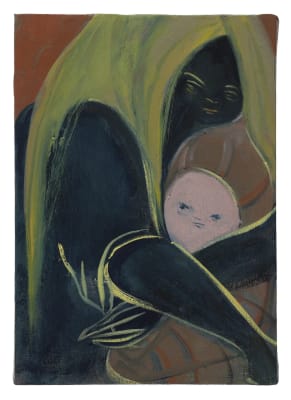
Recent works translate digital scans of single and double exposure polaroids, depicting a combination of both real people, and human-like computer-generated digital models.
My practice involves repetitively re-photographing a chosen source image of a “being” (real, or unreal) whilst it is present on a digital screen. This repeated process of data layering, degradation and distancing begins a journey of entropic decline; quietly inducing further distance between perceived realness and the data. At various points, the mediated data is translated into a painterly image. This final mediation introduces a biased handwriting and re-contextualises a fleeting digital image into an alternate, yet comprehensible, visual language.
Exploring both “life-size” figure translations of digital data and enlarged detail images play across the boundary between human and 'other' and tests the boundaries of innate human connection. Intentionally working with - and creating representations of - digital media, presents a materialisation of absence and grief; preserving a blankness through which projection can occur.
The translations are titled after the referent image file as a concrete reminder of the unreal origin and non-human genealogy of the illusionary form.