Ruth Bunnewell
Ruth Bunnewell is a painter working in oils.
She took a BTEC foundation diploma in art and design and a BA honours degree in fine art, both at Norwich School of Art and Design, and has stayed in Norfolk since, choosing local landscape as her subject. She has been shortlisted twice for the Sir John Hurt Art Prize, and was named in House and Garden as a rising British landscape artist.
Her work is represented by Gallery East in Woodbridge and Cambridge Contemporary Art, and she exhibits in solo and group shows across East Anglia and in London.
Artist Statement
'On the edge', is a theme that flows through my work; it is a constant that has been there even as far back as Art school days, when I was exploring ideas concerning the point at which a painting of a landscape stopped being representational, and became 'Abstract'. How far could a landscape be reduced, whilst still being seen as such? At what point does a painting become an 'Object', and not primarily about the place it conveys?
Whatever I choose to paint, I can always find threads of the same theme. I do not always intentionally choose this theme; but it feels like it must be inherent to who I am, as it constantly reappears.
The theme is this. Places that lie 'in-between', in the grey area, where one thing becomes something else. I am drawn to these liminal spaces. To me they hold a beauty, they exude ideas of possibility, of transition. Where nothing has a set definition, instead holding the as yet undecided future. They are Schrodinger's cat.
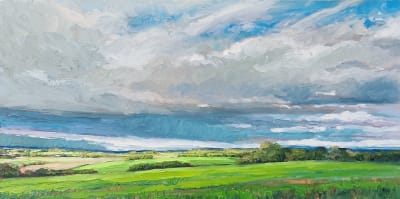
Physical places that I am drawn to paint are more often than not places that are on the outer edge, or in-between, whether that be roads, edges of towns, 'non-places' like roundabouts, edges of forests. It is always where one place is just about to change. Places that lie on the edge of definition.
The transitional nature of this theme continues when I choose to paint places that hold personal memories. Painting a 'non-place', such as a lay-by at the side of a road, transforming it from something un-special, into something valuable, adding value by the act of choosing to paint it, whilst painting it in a way to convey the beauty I see there. A non-descript lay-by on a road in the middle of nowhere already, for myself, containing beauty, because I one picnicked there as a child. It is this that fascinates me, the thing of beauty being in the eye of the beholder. A place or thing being defined by the viewer, and the understanding that there is the possibility of beauty, is it just a matter of defining it as such.
I think this is why I am drawn to paint places that at first glance seem quite dark or bleak, or non-descript; places that don't have an obvious connection with positive adjectives. Within these places, I can add in or draw out the positivity, re-defining, and highlighting the ethereal beauty within the liminal.
I was born and grew up in Norwich, and as a child daytrips to places in Norfolk and Suffolk were commonplace, and it is still these places that I am drawn to paint, as these places hold memories and feelings relating to memories. So I am often drawn to these places as a destination. The 'places' that I most like though can't really be easily named, as it is their 'non-place' status that appeals. They are places that are between villages, or fields glimpsed on my travels, and I am reluctant to define where they are, because it is the lack of definition that appeals. In doing this, I perhaps seek for myself to build a picture 'the essence of Norfolk', or the 'essence of places that appeal'. To be drawn, to look, to paint, to distil.
I work from photographs, generally finding a small section of the image that appeals that I can expand. Often I will paint the same scene repeatedly, because the same place is never the same place, maybe because of changing external factors such as the weather, or maybe because I bring to the place my own emotions, and 'atmosphere'.
I enjoy the process of changing somewhere that is at first glance quite un-noticed, into something familiar to me. It feels that it is giving respect and value to these beautiful, easily passed-by places. How often does a field at the side of a road get really looked at; but in that one view so easily missed there is a whole world.
Recently I have gone back to a few works that I thought were finished, realising that they were works that I was, or even still am, happy with, yet not really 'mine'. River Conifers was a painting that I loved, and had it hanging on my own wall. Seeing it every day made it very familiar until I stopped really noticing it. From experience I know that the paintings of mine that I'm completely satisfied with are ones that I never stop looking at. I reworked it, with additions of Neon, until it had the feeling that I'm always seeking, 'that's MY painting'. That's when I know a painting is finished.
Funnily enough, it is by painting that I have distilled and discovered things about myself. Why is it that I am drawn to the things that sit at the edge? Why am I fascinated by the act of defining?
Having had severe OCD as far back as I can remember, I have always sought to 'order things'. Not in a 'neat and tidy' sense, but rather in the sense of needing to understand what something 'is'. By defining things for myself I have been able to order them, in my mind, into 'good' and 'bad'. I have spent a lot of my life avoiding places and things that have bad connotations, and have learnt that this is quite a destructive way of living. By choosing to paint places that have no definition, it is my way of teaching myself that places and things are defined only by what you bring to them, that there are no intrinsic qualities inherent.
So again, the paintings have layered meanings. For me, they are a message to myself about living in a better way, hopefully for others they can be an exploration of places that sit 'on the edge', for others they can be about colours and forms and shapes. They can be whatever you see in them.