Belinda Downing
In 2025 Belinda Downing was selected for the Royal Academy Summer Exhibition and shortlisted for the Soho Open exhibition, and in 2026 she was selected for the John Ruskin Prize exhibition at Trinity Buoy Wharf, selected and written about in the a-n Degree Shows Guide and selected for the Gray Area Duality exhibition in Norwich. Downing has just been jointly awarded The Art Station Graduate Prize with a fellow student which provides them with 3 months' studio space, mentorship and a residency.
Downing has participated in two residencies on Orford Ness in 2024 (Make it Count) and 2025 (Camera O), exhibiting at the Power House on Orford Ness, and the Free Range residency at Letheringham Lodge in Suffolk in 2025, and she has participated in a number of group shows in Suffolk, at Artspace in Woodbridge, with the Ipswich Art Society in 2023 and other local artists in the Light and Line show in 2023.
Formal training: 1993 BA (Hons) Archaeology/History of Art, Bristol University (2:1). BA (Hons) Fine Art, University of Suffolk (1:1).
Artist Statement
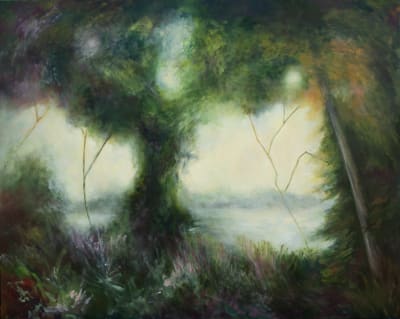
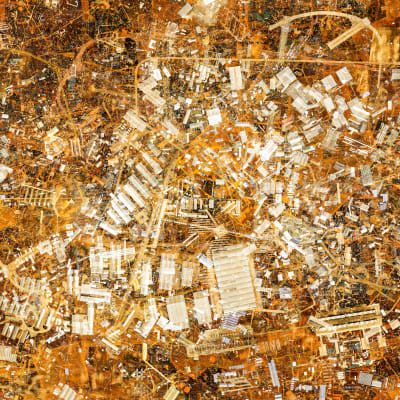
Influenced by her original study of ancient architecture, Downing is particularly inspired by dystopian contemporary ruins. Her work refers to the memories we might have of places in our past, using playfulness and tactility to engage the viewer. To explore this further she has been reading texts on painting in the expanded field by Rosalind Krauss and Gustave Fares. One of her touchstones is Lygia Clark, creator of interactive 'relational objects' designed to be moved by the viewer, and who reimagined the relationship between the viewer and the art object. The artworks Downing creates have these references at their core. The concept of time within art, whether it is Robert Smithson's idea of "Ruins in Reverse" where contemporary buildings become ruins even as they are being built, or Tacita Dean's notions of the outmoded and obsolete, has also become a framework for her paintings; they are not anchored to a particular time or event.
The paintings have had an architectural theme, but over time they have become semi-abstract. Downing has found that the interest in time and ruins led to her trying to depict the memory remaining in an actual place, and the result was disjointed and fragmented, as memory often is. This developed into a more formal concern that the focus is on place rather than space, each painting referring back to the original source material, a derelict or ruined building. To reference the memories left in a building after it has been vacated, Downing paints images on found boards or concrete, sourced from the original structure (when this is possible). In addition she uses metal hinges to create recto/verso paintings, or wheels attached to boards. These require the viewer to move them in order to see the whole piece, and tap into the human element of the installation.