Amy Stock
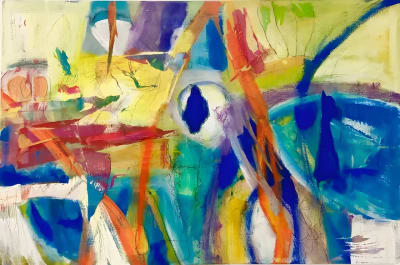
Amy Stock is a collage artist based in Lowestoft, Suffolk, whose work explores the relationships between shape, colour, and composition. Through carefully considered placement and juxtaposition, she creates visually engaging works that investigate balance, rhythm, and spatial interaction.
While her current practice centres on collage, Amy's background in Graphic Design remains evident throughout her work. The use of flat colour, bold forms, and strong compositional structures reflects a graphic sensibility, combining precision with playful experimentation; her work often focuses on how simple visual elements can be rearranged and reinterpreted to create new meanings and connections.
Amy studied Art and Design at Suffolk College (2002–2004) before completing a BA (Hons) in Graphic Design at Norwich School of Art & Design (2004–2007). She later gained a PGCE from the University of Suffolk (2011–2012), combining her creative practice with a commitment to arts education.
She has exhibited widely across Suffolk and Norfolk, both independently and as a member of the Easterly Artists collective between 2021 and 2025. Recent exhibitions and commissions include Hãm in Lowestoft (2026), the commissioned installation for ‘High Voltage’ at The Battery of Ideas, Lowestoft (2025), the inaugural ‘Summer Show’ at 303 Projects (2021), ‘For Suffolk Sake’ at The Art Station, Saxmundham (2021), ‘Animal, Vegetable, Mineral’ at The Art Station (2022), and ‘Unconsumed’ at The Shoe Factory, Norwich (2023).
Artist Statement
My current creative practice is centred around exploring shape, placement and colour, and the relationships that emerge between these elements.
I work predominantly with collage, drawn to its fluid and responsive nature. The process of adding, removing and repositioning forms allows each piece to evolve organically, and it is often this act of making, rather than the finished outcome, that I feel most deeply connected to.
Working with waste and discarded materials plays a significant role in my practice. These fragments are often remnants from previous collages, offcuts from my children's artwork, found objects, or items collected through my work; I am particularly interested in preserving the shapes that remain after something has been used or removed. Rather than altering these forms, I respond to them, exploring how they can create new visual relationships and unexpected compositions.
Work
Photo: Debby Besford