Nicola Burrell
Nicola Burrell is a painter and sculptor based in Colchester. She took a Datec diploma at the North Essex School of Art, then a BA (Hons) in Fine Art at the University of Ulster at Belfast, followed by an MA there, an exchange to the Escola Massana in Barcelona and a PGCE in Art and Design at Goldsmiths College. She is a member of the Royal Society of Sculptors.
Much of her work is public. Her concrete and steel sculptures stand across Essex and Hertfordshire, among them New Town at the Florence Nightingale Health Centre and at Burnt Mill School in Harlow, Mersea Island at Mersea Island Primary School, Water Mill on the River Stort, and Diamonds and Stars in Castle Park, Colchester. Her concrete relief Hythe, made for Generart Phase 3 in Colchester, won a RIBA Art in the Built Environment Award in 2006. Earlier commissions include Around the World for the children's ward, waiting areas and burns unit at Broomfield Hospital in Chelmsford, and Homage to Goethe, commissioned by firstsite for the town hall at Wetzlar in Germany.
Her one person shows include Urban Paintings at the Gibberd Gallery in Harlow, for which the artist Nick Bullions wrote an accompanying paper, Concrete and Sand at Colchester Central Library, and Heads at the Naze Tower in Walton-on-the-Naze. She has also shown at Ipswich Museum, at the University Gallery at the University of Essex, at Gainsborough's House in Sudbury and at the Minories.
Alongside her own work she has extensive experience of running public and community art projects, and is particularly known for making cardboard artworks in schools.
Artist Statement
I am a maker of obviously 'assembled' or 'constructed' things; that create pictures, tell stories; and respond to people and places.
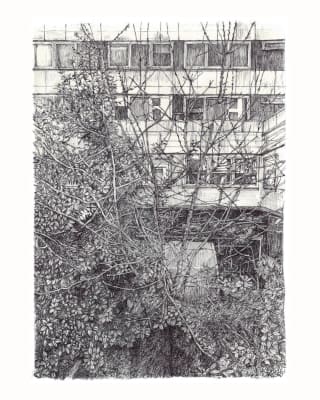
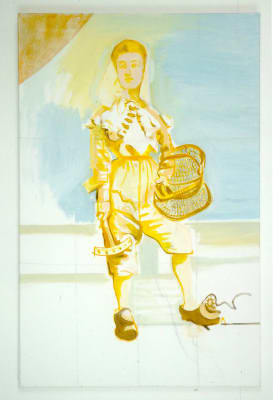
This interest in the 'constructed' naturally leads me to the built environment as my main inspiration. I always begin with drawing; capturing the character of a place and of inhabitation. I incorporate found materials to build-up the surface of my paintings into three-dimensional relief, which creates an effect of 'super-perspective'. The paintings are often made from hundreds of little found pieces.
I have always also made sculptures and reliefs; and for the last ten years I have been developing a series of sculptures in concrete and steel which have been inspired by the forms of the urban landscape. My sculptures begin with an observation of a place and a subject. I work in an intuitive way, usually aiming for the work to be contextual in a double sense; relating to their setting in both a visual and thematic way, creating the fullest resonance with a place.
I have found ways of making highly coloured and precise concrete. My steel sculptures are always brightly painted. Sometimes the sculptures are more pictorial, and sometimes more abstract. Often they owe something to a more collage-like method of composition, even when realised in a solid and monolithic form. The more abstracted ones owe something to architectural composition in that they are clearly formed from an assembly of separate elements.
Whether working on something that is more sculptural or more painterly I nonetheless think in a 'constructional', rather than what might be called a 'plastic' way. This 'building-up' follows my intuitive methods, where being hands-on with my materials is part of how I think. For me this is part of the life and vitality of the work. On the one hand I want to capture a sense of life in forms and places, and I want to create work where the gestures of its making are present in the finished piece.